
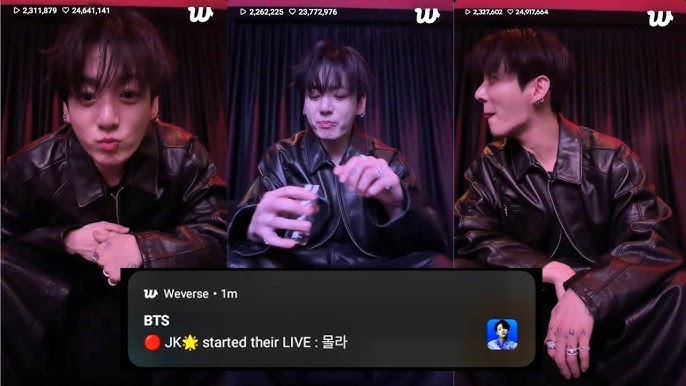
SEOUL — In the early hours of February 26, 2026, BTS’s Jungkook did something that would be considered ordinary for a global pop star but remains revolutionary in the world of K-pop. During a spontaneous, late-night Weverse livestream, the “Golden Maknae” appeared in a candid state, sharing drinks with friends and his older brother, using casual language, and addressing long-held taboos like his past smoking habits and the stifling nature of corporate and public surveillance.
This wasn’t just a “drunk live”; it was a manifesto of an artist navigating the agonizing “growing pains” of a transition. For decades, the K-pop industry has been built on the bedrock of Neo-Confucian values—demanding that idols serve as paragons of modesty, unwavering politeness, and moral purity. In this cultural framework, an idol is not a private individual but a public commodity whose personal choices are subject to collective approval.
Jungkook’s frustration was palpable. “I’m a person too,” he reminded his millions of viewers, expressing annoyance at the constant need for “company approval” and the public’s tendency to “boss him around.” By openly discussing his struggle to quit smoking and using profanity to express raw emotion, Jungkook is effectively dismantling the “Idol” archetype to reveal the “Artist” underneath.
This moment signifies a critical cultural shift. Jungkook is no longer willing to play the role of the “perfect son” dictated by traditional Korean social hierarchies. His “rebellion” is a necessary evolution for K-pop to survive as a global art form. As BTS prepares for their March 2026 comeback, Jungkook is proving that true global influence comes not from flawless imitation, but from the messy, authentic, and often controversial freedom of the individual. He is sublimating from a manufactured icon into a liberated artist, forcing Korean society to confront the limits of its conservative expectations.