
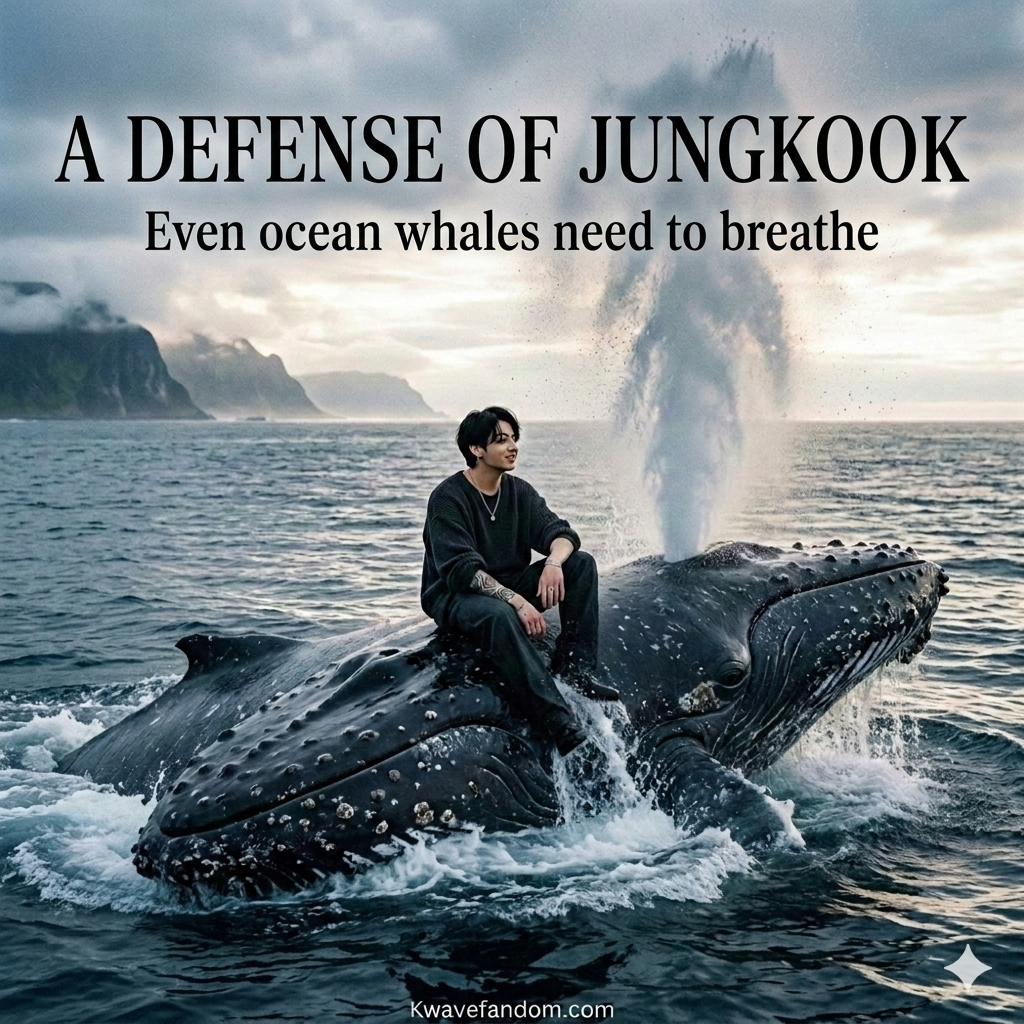
Los Angeles | High above the frigid currents of the Pacific, a humpback whale breaks the surface. It is a violent, necessary explosion of life. For a creature that weighs forty tons, the act of breathing is not a passive reflex; it is a conscious, strategic exertion. If a whale remains submerged for too long, carbon dioxide builds in its blood, muscles cramp, and the very pressure of the deep begins to crush its spirit. To survive the marathon of the ocean, the whale must rise. It must vent. It must spray a mist of saltwater and oxygen into the air, a momentary “blow” that signals to the world: I am still here, and I am still alive.
Lately, I’ve been thinking about this “blowhole” effect while watching the digital storm surrounding Jungkook, the “Golden Maknae” of BTS. In a recent late-night livestream, the world’s most famous 28-year-old was seen being human. He was unfiltered, perhaps a bit tipsy, speaking with a raw honesty that skipped the teleprompter of his agency. To some, this was an “escapade” or an “unprofessional lapse.” To me, it looked like a whale breaking the surface for a desperate breath of air.
For over a decade, the members of BTS have lived in a palace made of glass. Since their days as teenagers, their lives have been a relentless grind. Consider the K-pop trainee system: a hyper-competitive pressure cooker where teenagers trade their youth for sixteen-hour days of synchronized dancing, vocal drills, and “personality training.” It is a world where “Asian student excellence” is the baseline.
Compare this to the Western rock-and-roll archetype. Do K-pop stars engage in hotel-wrecking orgies? Do they crash Ferraris or publicize drug benders? No. They are expected to be the ultimate polite students. They cannot openly date; they cannot express political dissent without a PR firestorm; they cannot even have a private glass of whiskey without someone on the internet calling for an apology. They are global ambassadors carrying the GDP of a nation on their shoulders.
Jungkook, in particular, is an artist of profound sensitivity. Having jumped into the K-pop machinery as a young teen, he skipped the messy, trial-and-error phase of adulthood that the rest of us take for granted. He traded “growing pains” for “global gains.” But the human psyche isn’t a machine; it demands its pound of flesh.
We’ve seen this before in the history of pop groups—from the Beatles’ internal fractures to the tragic burnout of One Direction. The “Crown of BTS” is heavier than most. The pressure of a 2026 comeback, with the eyes of billions waiting to see if they can still define the zeitgeist, is enough to flatten any ego.
This brings us to Arirang, the quintessential Korean folk song. It is a song of Han—that uniquely Korean blend of deep sorrow, resentment, and hopeful resilience. When BTS reinterpreted Arirang for the global stage, they didn’t just sing a melody; they exported a national trauma and its subsequent triumph. The traditional Arirang is a song of a traveler crossing a mountain pass, weary but moving forward. BTS’s version is the same traveler, but now he is wearing Dior and performing in a stadium, yet still feeling the same ancient, heavy ache of the climb.
Why did they choose Arirang? Because at their core, they know that to be Korean is to understand that beauty is inseparable from struggle.
We need to look at Jungkook with the affectionate eyes of a gardener, not the cold eyes of a judge. Just as the whale’s spray is a sign of survival in the vast, lonely ocean, Jungkook’s late-night outbursts and his “unfiltered” moments are his way of venting the pressure. It is his way of ensuring he doesn’t drown in the very success we have helped create for him.
If we want the music to continue, we must allow the artist to breathe. Let us recognize his “deviations” not as flaws, but as the vital, gasping breath of a creature who has been underwater for far too long. In the end, even the most majestic whale needs the surface. And Jungkook, like the song Arirang, is still in the middle of his long, beautiful climb over the mountain pass.