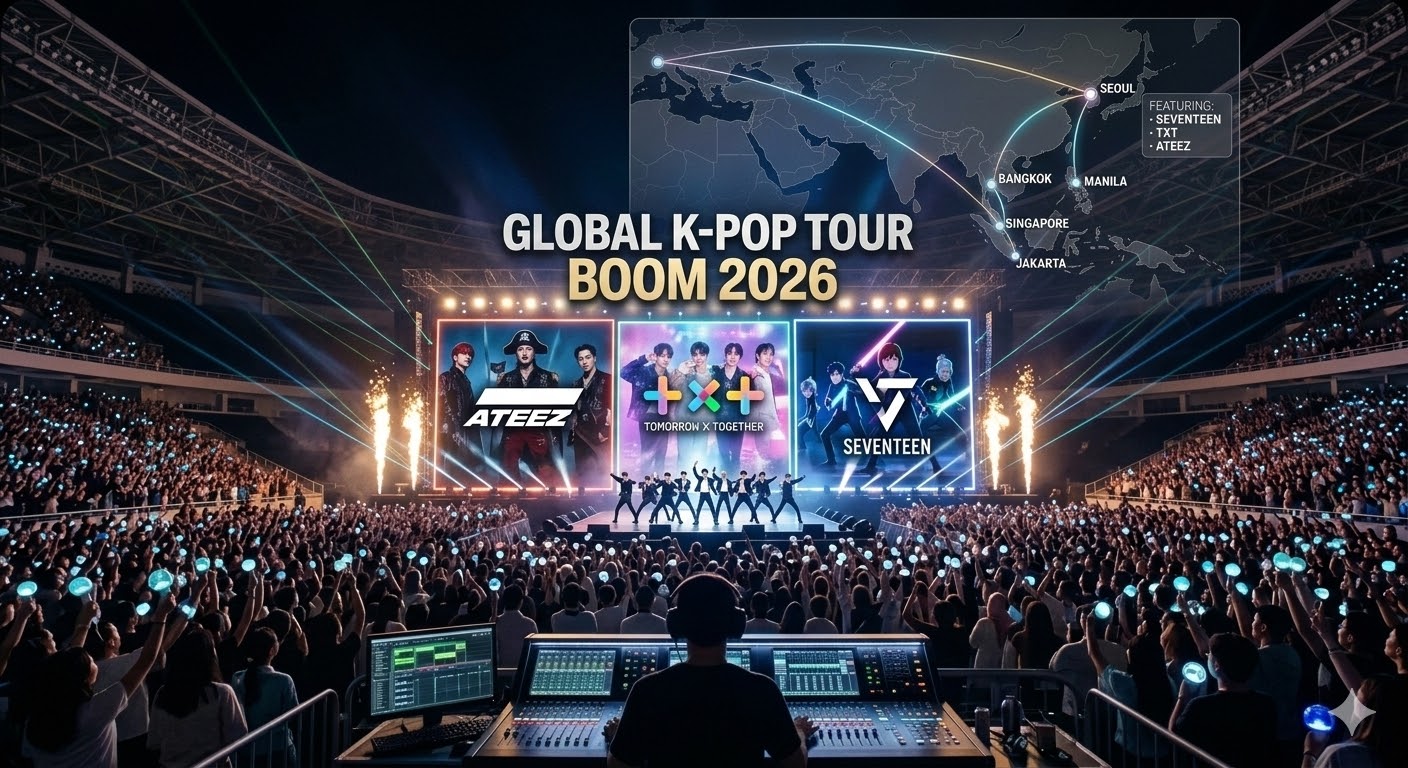
Southeast Asia emerges as a “Gold Mine” for K-Pop; SEVENTEEN, ATEEZ, and TXT lead a multi-billion dollar touring wave across the region.
The “K-Pop Fever” that skeptics once predicted would cool off has instead reached a boiling point in 2026. As the global music industry stabilizes in the post-pandemic era, the live performance sector has become the primary engine driving the Korean Wave (Hallyu). Nowhere is this more evident than in Southeast Asia, a region that has transformed from a passionate fan hub into one of the most sophisticated and profitable concert markets in the world.
According to recent industry data, the demand for K-Pop live experiences has hit an all-time high, with 2026 shaping up to be a record-breaking year for ticket sales, VIP packages, and ancillary revenue.
The 2026 Roadmap: A Region Painted in K-Pop Colors
The current touring calendar looks like a “Who’s Who” of global music icons. Leading the charge are several powerhouse boy groups, each bringing their unique brand of high-octane performance to major stadiums and arenas across Thailand, Indonesia, the Philippines, Vietnam, and Singapore.
- SEVENTEEN: Following their massive success in the West, the group has returned to their roots in Southeast Asia with an upgraded stadium tour. Their ability to sell out multiple nights in cities like Bangkok and Jakarta highlights the deep, multi-generational loyalty of their fanbase.
- ATEEZ & TXT (Tomorrow X Together): Representing the vanguard of “performance-heavy” K-Pop, both groups have seen a geometric increase in their Southeast Asian audience. Their 2026 tours are characterized by high-concept stage productions that rival Western pop spectacles, proving that the region is now ready for—and demanding—top-tier production values.
- NCT Units: From the polished pop of NCT DREAM to the experimental edge of NCT 127 and WayV, the brand’s multi-unit strategy has allowed it to blanket the region, touching every corner of the Southeast Asian market simultaneously.
The Strategic Shift: From “Promotional Stop” to “Profit Center”
Historically, Southeast Asia was often viewed by major entertainment agencies as a “promotional” territory—a place to build brand awareness rather than generate massive profits. In 2026, that narrative has been completely discarded.
The region has officially become one of the most profitable markets for K-Pop outside of South Korea. Several factors have contributed to this economic shift:
- Rising Middle Class: A growing demographic with disposable income is willing to spend on premium concert experiences and official merchandise.
- Infrastructure Development: The opening of world-class venues like the Philippine Arena and various new indoor stadiums in Jakarta and Ho Chi Minh City has allowed for larger capacities and better logistics.
- Digital Integration: The high penetration of social media and streaming platforms in Southeast Asia ensures that new hits reach fans instantly, maintaining a constant state of “comeback” excitement.
The Macro-Economic Impact: A Multi-Million Dollar Export
The significance of these global tours extends far beyond the stage. For the South Korean music industry, overseas markets are now the lifeblood of their financial sustainability.
Industry analysts estimate that international tours and related activities generate hundreds of millions of dollars in revenue annually for Korean entertainment companies. This revenue stream is diversified across ticket sales, high-margin tour merchandise, corporate sponsorships, and “fan-meet” events.
“We are no longer just exporting songs; we are exporting a comprehensive cultural infrastructure,” says a market analyst specializing in the Asian entertainment sector. “The 2026 tour boom in Southeast Asia demonstrates that K-Pop has moved past being a ‘trend’ and has become a permanent, high-revenue pillar of the global entertainment ecosystem.”
The Ripple Effect: Beyond the Big Names
The success of titans like SEVENTEEN and TXT is also opening doors for mid-tier groups and soloists. As promoters in Southeast Asia gain confidence in the “K-Pop Brand,” they are increasingly willing to take risks on smaller acts, creating a more diverse and resilient ecosystem. This “trickle-down” effect ensures that the pipeline of talent remains robust and that the market remains saturated with fresh content.
As we look toward the second half of 2026, the momentum shows no signs of slowing. With rumors of new girl group tours and collaborative music festivals on the horizon, Southeast Asia remains the glowing heart of the global K-Pop explosion.